
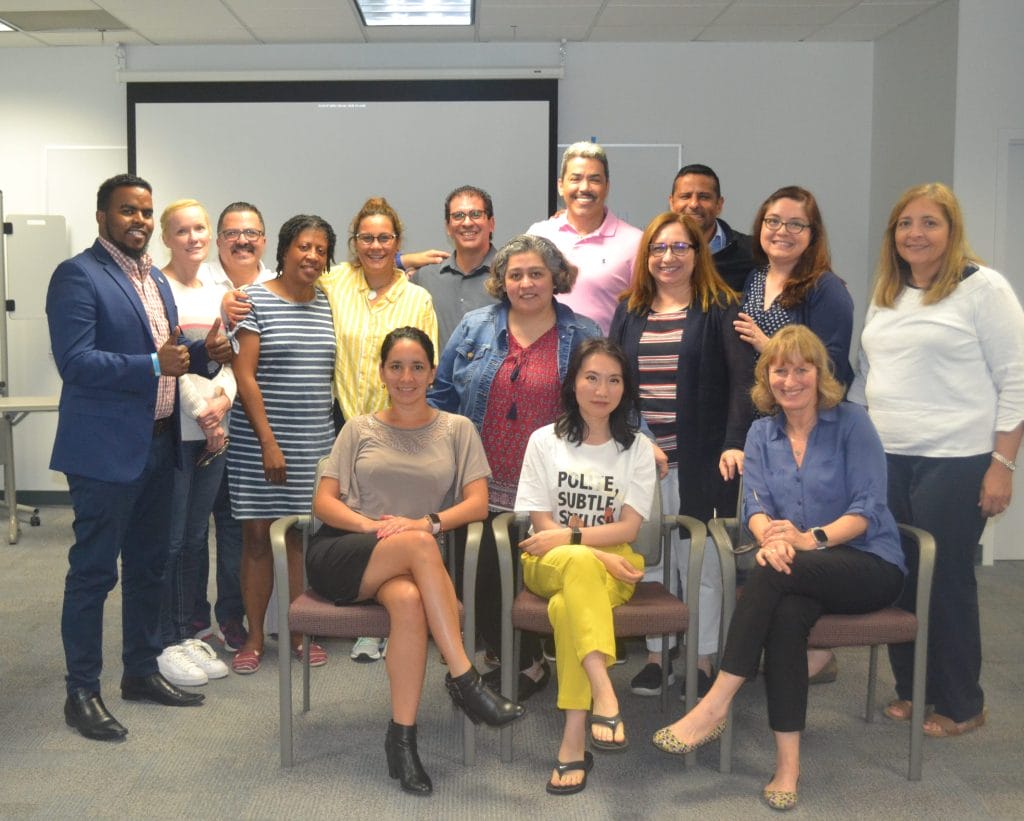
With over 46 million immigrants in the U.S., the demand for qualified interpreters is growing across healthcare, education, human services, and legal sectors.
If you’re 18 and over, have a high school diploma or equivalent, and speak or sign at least two languages, you could pursue a career in interpreting. Most industries require interpreters to have completed a 40-hour certificate program, at a minimum, before being able to work as an interpreter.
Our Community Interpreter® 40-hour certificate programs are the most trusted and widely taught curriculum for community interpreting, essential for interpreters who are just starting their career or those pursuing a specific certification.
Choose Live Online:
The Community Interpreter® International
Or Self-Paced:
The Community Interpreter® Online
The Medical Interpreter Online
Select Your Specialization to Find Certification Providers:
Two national organizations certify medical interpreters, Certification Commission for Healthcare Interpreters (CCHI) and The National Board of Certification for Medical Interpreters (NBCMI).
CCHI provides certification preparation resources, including practice tests. NBCMI also provides certification preparation resources.
Credentialing of state court interpreters is done by the individual states. The National Center for State Courts (NCSC) offers extensive information, legal glossaries, and exam preparation for state court interpreter certifications as well as a map of language access programs for each state.
The Federal Court Interpreter Certification Examination (FCICE) is a standardized assessment used to certify interpreters for federal court proceedings across the United States. It is administered by the Administrative Office of the United States Courts.
Registry of Interpreters for the Deaf (RID) offers certifications and certification maintenance programs for American Sign Language (ASL) interpreters.
The Board for Evaluation of Interpreters Certification Program (BEI) also certifies the skill level of ASL interpreters. Although based in Texas, the BEI certification is used and recognized in several states for ASL interpreters.
The Washington State Department of Social and Health Services certifies its bilingual staff; social service and medical interpreters; and translators working throughout its many divisions and programs.
Choose Live Online:
One-Day Training Sessions
Webinars
Or Self-Paced:
Short Courses


What’s the difference?
A certificate is often required before pursuing certification. Certificates demonstrate completed training, while certifications verify skills and expertise. It is crucial to obtain certificates and certifications from a recognized organization to ensure credibility and industry-wide recognition.
Take our FREE 2-hour self-paced course to learn more about interpreter credentials and certification.
Intersect is our weekly e-newsletter with breaking news on language, culture and interpreting. Join 20,000+ subscribers in over 100 countries!